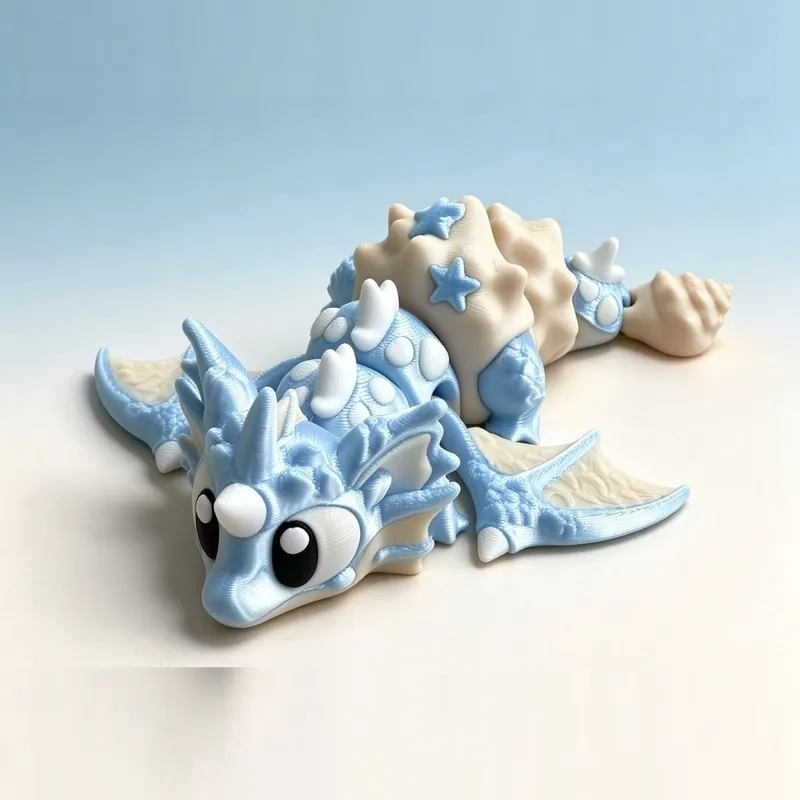
Flying dragons
Flying dragons, printed as one moving piece
Wings out, tail curled. Eleven designs, each printed flat and lifted off the bed already assembled — no glue, no clips, no bag of small parts.


What “articulated” actually means here
Every vertebra in the body is a printed hinge: a pin of plastic sitting inside a socket with two or three tenths of a millimetre of clearance. Nothing is assembled afterwards. The dragon comes off the print bed as one object, and that single object moves.
Pick one up by the tail and the whole spine follows. Lay it on a desk and it holds whatever curve you leave it in, because the clearance is tight enough to create a little friction at each joint — that is the difference between a toy that flops and one that poses.
Size, weight and how they sit
Most flying dragons measure 10–11 cm from nose to tail tip with the wings spread, and weigh under 30 grams. They are light enough to sit on a monitor stand or a shelf edge without a base, and small enough to hold in one hand.
The wings are printed as a single bridge of material rather than two halves, so they will flex but not separate. They are decorative — a display piece, not a toy for a four-year-old. We recommend 14+ and mention it plainly on every product page.
Colour, material and finish
Everything is PLA, printed to order in Shenzhen in 2–3 business days. Multi-colour pieces are printed with colour changes at set layer heights, which is why the bands follow the body rather than being painted on afterwards.
PLA is a plant-derived plastic with a low softening point: around 60 °C. A car dashboard in summer will ruin one; a windowsill in direct sun might. Keep them indoors and they will outlast the shelf they sit on.
Flying dragons: common questions
Do the wings and tail actually move?
Yes. The spine, tail and wing roots are printed hinges with real clearance, so they move from the moment the piece comes off the printer. There are no metal pins and nothing to tighten.
How big is a flying dragon?
10–11 cm from nose to tail tip with the wings open, roughly the length of a house key. Each product page lists the exact measurement for that design.
Can it stand on its own?
Not upright — flying dragons are designed to lie flat or drape over an edge. If you want something that holds a standing pose, look at the standing dinosaurs instead.
Is it safe for children?
We list these as 14+ display pieces. The joints are strong but the wings are thin, and a determined toddler can break a wing tip. They are not certified as toys for young children.
Keep looking